
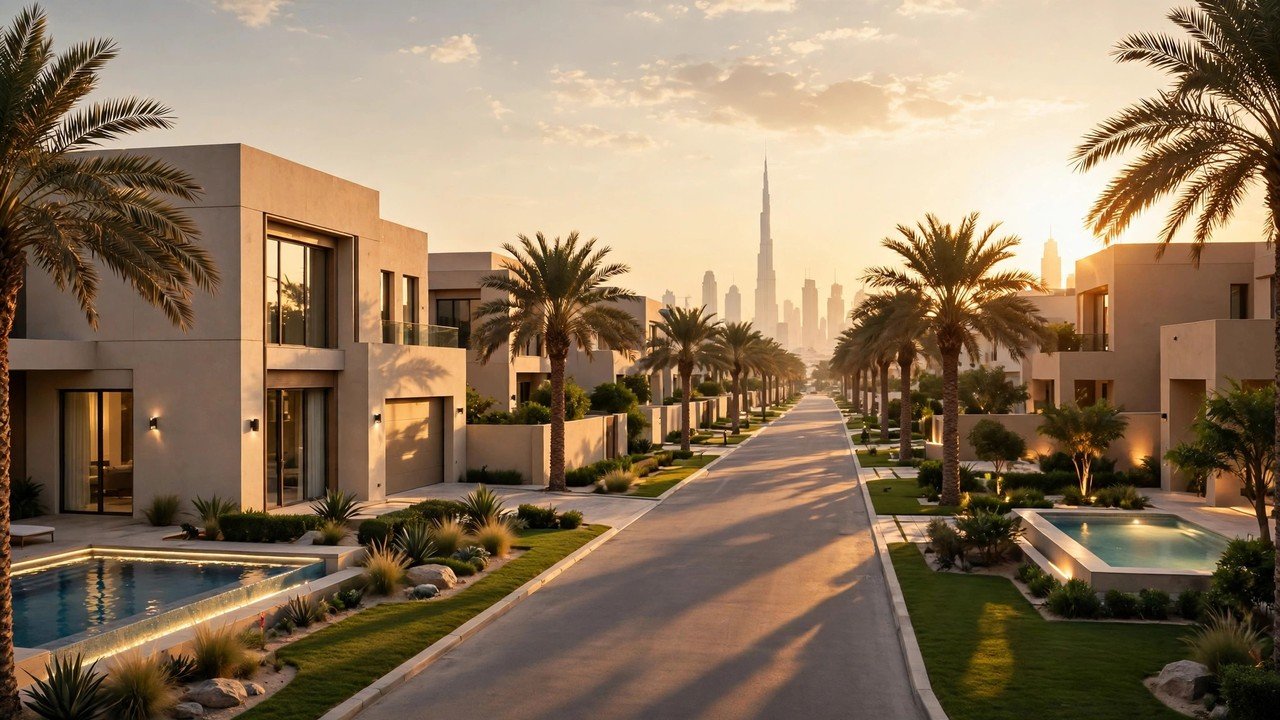
If you have been watching Dubai villas November 2026, here is the surprise: while apartment prices eased through the autumn, villas went the other way. Villas and townhouses kept selling and kept holding their value, and in several family communities they are harder to find than a year ago. The market is splitting in two — apartments softening on new supply, villas staying firm on family demand — and if you want space, a garden and a gate of your own, November is a good month to understand exactly what that costs. Dubai villas November 2026: the numbers behind the move The October data tells the story plainly. Happy Endpoint counted 1,649 villa and townhouse sales in October 2026, at a median price of AED 4.04 million and AED 1,684 per square foot — up 3.0% on a year earlier. Compare that with apartments: 8,633 sales at a median of AED 1.15 million and AED 1,660 per square foot, down 3.2% over the year. Villas are now selling for more per square foot than apartments, which is rare, and it shows where the demand sits. Other sources point the same way. DXB Interact, via haus51, counted 1,356 villa sales worth AED 9.1 billion in October, PropertyIndex put the average ready villa at AED 6.2 million, and Savills recorded a median of AED 1,638 per square foot for villas and townhouses in September, up 4.1% on the year. CBRE’s Q3 review has villa prices about 1% higher than a year ago, while apartment prices were about 2% lower. Rents tell a similar story. CBRE puts villa rents just under 6% lower than a year ago, against 7% for apartments — and Savills notes that family villas and townhouses in established communities remain tight, even as rents in Dubai Marina, Business Bay and JVC have fallen by double digits this quarter. The softening is concentrated in apartment towers. The villa market is a different conversation. Where villa buyers are looking The Dubai villas November 2026 picture is not one market but many, and the community you pick matters more than the city average. TRPE’s guide, using Dubai Land Department sales from January to October 2026, gives a useful spread of typical prices: The Valley: a typical 3-bedroom at AED 2.8 million, 4-bedroom-plus at AED 3.4 million, around AED 1,367 per square foot. Villanova: a typical 3-bedroom at AED 2.865 million, 4-bedroom-plus at AED 3.685 million, around AED 1,448 per square foot. Arabian Ranches 3: a typical 3-bedroom at AED 3.0 million, 4-bedroom-plus at AED 4.26 million, around AED 2,069 per square foot. Arabian Ranches: a typical 3-bedroom at about AED 5.0 million, around AED 1,402 per square foot. The 90-day medians from DLD open data add more: Dubai South villas at AED 4,945,000, Dubai Hills Estate at AED 5,525,000, Motor City at AED 7,000,000, Jumeirah Village Circle at AED 3,100,000, and The Valley at AED 3,552,888. At the top end, the week’s register to 3 November recorded a Palm Jumeirah Garden Homes villa at AED 60 million and an Arabian Ranches villa at AED 21 million. New villa launches to watch in November The Dubai villas November 2026 launch list is short, and that is part of the story. Savills counted only about 5,000 units launched in the third quarter, and roughly 50,000 across the first nine months — around 64% below the same period last year. Fewer launches mean less future competition for today’s villa owners, but also fewer chances for buyers waiting for something new. Three villa and townhouse projects are on the November watchlist. Palm Springs by Nakheel, near Palm Jebel Ali, is being promoted with three- to five-bedroom townhouses and villas from around AED 3.8 million, though Nakheel has not published a confirmed final launch package. Ellington Properties is planning a villa and townhouse community near Town Square and Mira Oasis, with indicative pricing around AED 1,700–1,800 per square foot and expected handover in 2030–2031. Aldar is preparing a villa and townhouse development near Dubai Silicon Oasis, with a starting price around AED 2.7 million. Treat all three as preliminary: prices, payment plans and dates are subject to developer confirmation, and a 2030 handover is a long wait for a family that needs a home now. Villa or townhouse: which costs less? This is the question most family buyers actually ask, and the honest answer is that the Dubai Land Department does not split its sales data into townhouses and villas, so there is no official price gap. In practice, a townhouse is usually the cheaper way into a family community: you share walls, you get less land, and the ticket is lower — a typical 3-bedroom townhouse in The Valley at AED 2.8 million against a standalone villa in the same area at a clear premium. Before you choose, check the running costs, not just the price. Service charges vary sharply between communities, and the RERA Service Charge Index shows the approved fees by project. A villa with a private pool also means pool maintenance, garden upkeep and higher DEWA bills. Ask the agent for the last year’s service charge and utility costs on the specific home — that is where the real monthly difference between a townhouse and a villa shows up. What this means for you For the Dubai villas November 2026 buyer, the practical read is straightforward. If you are a family buying to live in, do not wait for a villa discount the data does not support — but the softer wider market means sellers of villas are still open to a serious, well-prepared offer, especially on homes that have sat listed for months. Count the real cost before you offer. On a median AED 4.04 million villa, a 20% deposit is about AED 808,000, and purchase costs — the 4% DLD transfer fee, a 2% agent fee, mortgage registration and valuation — add roughly 7%, or about AED 283,000. Get a mortgage pre-approval first, and compare ready villas with the new

The Yards Dubai: Beyond Developments Launches AED 4 Billion Masterplan
Dubai’s developers rarely do anything quietly, and the latest headline proves it. The Yards Dubai is Beyond Developments’ newly unveiled AED 4 billion (roughly $1.09 billion) masterplan in City of Arabia, and it marks the developer’s first inland project after a run of high-profile waterfront addresses. For investors who have spent the past two years watching prime coastal prices climb out of reach, this launch lands at an interesting moment. The pitch is simple but deliberate: a low-rise, nature-led community in a fast-growing corner of Dubailand, built around green space rather than towers. Beyond is betting that the next wave of buyer demand will move inland, toward integrated neighbourhoods that feel calmer and more liveable than the city’s dense seafront clusters. Whether you are a homebuyer, a yield-focused investor, or a developer studying the competition, The Yards is worth a closer read. What Is The Yards Dubai? The Yards Dubai is a master-planned destination spanning 2.3 million square feet of gross floor area in City of Arabia, part of the wider Dubailand district. At full build-out it will house 1,560 residential units, ranging from one- to three-bedroom apartments, alongside retail, food and beverage, and community amenities. The design language is Mediterranean-inspired and built around a one-kilometre green spine, with around 70 per cent of the total area set aside as open landscape. That is a striking ratio in a city where developers often maximise sellable floor area, and it signals where Beyond wants to position the product: human-scale living with nature at the centre rather than as an afterthought. The vision is clear in how the company talks about it. Adil Taqi, CEO of Beyond Developments, described The Yards as a commitment to a district where scale, connectivity, and a genuine scarcity of quality supply are converging to create one of Dubai’s more compelling long-term investment cases. In other words, Beyond is not chasing existing demand; it is positioning ahead of it. Beyond Developments itself is no newcomer. Its portfolio already spans some of Dubai’s most recognisable waterfront locations, including Palm Jumeirah, Dubai Islands, and Dubai Maritime City, plus projects in the northern emirate of Ras Al Khaimah. The Yards is its first significant inland Dubai destination, which makes the launch a strategic pivot as much as a new address. Ramzi Rahal, the company’s Chief Development Officer, framed the project’s first cluster as the piece that establishes the character of the entire masterplan. Key Features of The Yards Masterplan So what actually sits inside the masterplan? The first phase gives a concrete picture of the experience Beyond is building, and it tells you a lot about who the community is for. Residential offerings. The debut cluster, Arancia Yards, brings 272 residences across three low-rise buildings in one-, two-, and three-bedroom layouts. The low-rise, landscape-first approach is a deliberate counterpoint to Dubai’s high-rise norm, aimed at buyers who want light, space, and a sense of neighbourhood. Retail and commercial spaces. Arancia integrates more than 2,000 square metres of retail and food and beverage space at ground level, so daily errands and casual dining sit within the community rather than a drive away. As later phases come online, the wider masterplan is set to deepen this everyday-convenience layer. Hospitality and lifestyle components. Mediterranean-inspired public realm, rooftop terraces totalling around 3,000 square metres, and a 4,200-square-metre landscaped sunken garden form the social heart of the first cluster. These are the kinds of shared spaces that turn a housing project into a place people actually gather. Public spaces and community amenities. The one-kilometre green spine threads through the masterplan, with roughly 70 per cent of the site given over to open landscape. Expect walkways, gardens, and gathering points engineered for well-being rather than density. Walkability and lifestyle focus. The whole layout leans into pedestrian-friendly, nature-integrated living. It is a clear response to a real gap in Dubai’s inland premium supply, where buyers increasingly want the calm of a garden community without sacrificing connectivity. Why City of Arabia Is Emerging as a Prime Real Estate Destination Location is doing a lot of heavy lifting in this story, and it deserves scrutiny. City of Arabia is a master-planned district within Dubailand, conceived as a fully integrated, walkable urban environment that blends residential, commercial, and recreational uses. Strategic location. The district sits along Sheikh Mohammed Bin Zayed Road (E311), one of the emirate’s primary arteries, with nearby access to Al Khail Road (E44) and Emirates Road. It is positioned close to landmarks like IMG Worlds of Adventure and Global Village, and neighbours established communities such as Al Barari. Infrastructure growth. Dubailand has steadily filled in over recent years, with schools, clinics, retail, and leisure anchors maturing around it. As the surrounding road and transport network keeps improving, inland districts like City of Arabia stand to benefit from rising accessibility. Connectivity to major Dubai landmarks. From here, Downtown Dubai, Dubai Marina, and Dubai International Airport are typically within a 20 to 30 minute drive. That central-but-calm positioning is precisely what makes inland Dubai attractive to families and long-term residents. Long-term investment appeal. Here is the honest caveat an investor should weigh: City of Arabia is car-led, with no metro station inside its borders today, though planned transit links are expected to improve that over time. The flip side is opportunity. Buying into an area still in its growth phase, at earlier pricing, is exactly how patient investors capture appreciation as infrastructure catches up. How The Yards Fits into Dubai’s Real Estate Growth Story Zoom out, and The Yards is riding several structural trends rather than a passing fad. That distinction matters when you are committing capital for years, not months. Rising demand for integrated communities. Buyers increasingly want neighbourhoods where they can live, work, shop, and unwind without long commutes. Master-planned, amenity-rich communities have outperformed precisely because they answer that lifestyle shift. Population growth. Dubai’s population has pushed past four million and continues to expand, adding tens of thousands of new residents each year. More people means